

By Bomba Dauda
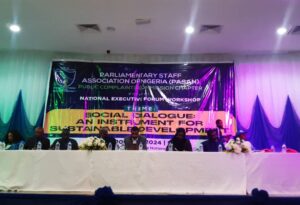
Being a Keynote delivered by Gloria Mabeiam Ballason Esq at the National Workshop of the Parliamentary Staff Association of Nigeria (PASAN) on 19 August, 2024 at the Royal Choice Inn Hotel, Abuja F.C.T.- Nigeria.
PROTOCOLS:
Thank you for the privilege to be invited to speak on Social Dialogue and its nexus to sustainable development. This is a worthy conversation to have especially with parliamentary staff across Nigeria moreso because, in the words of one of America’s monumental cultural poet, Henry Wadsworth, a single conversation across the table with a wise person is better than ten years of book study. I imagine that this reasoning, being extended to social dialogue with workers in the parliamentary space not only allows for ideas and critical thinking that enables us reach common grounds and democratic developments, but it also has the potential to enable us find solutions that are just and sustainable.
WHY SOCIAL DIALOGUE?
If it is true that questions tell us more than answers ever will, as I think it is, then we must pause to ask: Why Social Dialogue?
Europe had a head start in the practice of tripartism between governments and the representative organizations of workers and employers within and across borders.They find social dialogue relevant in achieving solutions and to building up social cohesion and the rule of law through, among other means, international labor standards.
The International Labour Organisation (ILO) put language to this structured social interaction to mean all types of negotiation, consultation or simply exchange of information between or among, representatives of governments, employers and workers on issues of common interest relating to economic and social policy. In which case, it can exist as a tripartite process with the government as an official party to the dialogue or it may consist of bipartite relations only between labour and management or trade unions and employers’ organizations.
Social dialogue has demonstrated its potential to promote democratic governance and participation as well as economic stability and progress.
Through social dialogue, individuals are able to exchange ideas, express opinions and engage diverse perspectives leading to increased awareness, empathy and cooperation for the building of a more inclusive and cohesive society where mutual respect and understanding thrive.
Put more starkly: if you think talk is cheap? Try its absence in governance. So I guess it is a safe place to establish that to have the right governance or to build development that is sustainable, having different perspectives must be normalized, encouraged and welcome. Anything outside that circumference, is anomalous.

X-RAYING SOCIAL DIALOGUE INFLUENCES IN SOME CLIMES.
So how has Social Dialogue work in other climes? I’m glad you asked. Several countries such as Sweden, South Africa, Norway, Denmark, the Philippines and Indonesia have effectively utilized social dialogue to address various challenges and promote social cohesion.
In Sweden for example, social dialogue has been instrumental in resolving labour disputes and fostering cooperation between employers and employees. In South Africa, social dialogue played a crucial role in the transition from apartheid to democracy, facilitating reconciliation and nation-building efforts. Norway and Denmark have effectively utilized social dialogue to address gender equality and work-life balance challenges.
The Philippines stands out as the first Asian country to effectively leverage social dialogue to address societal issues and promote harmony within its community while Indonesia deployed social dialogue achievement through the significant increase in minimum wage as a result of which all major industrial cities increased minimum wages above 100% with the objective of gradually shifting the economy from low cost labour to a skilled workforce.
These examples highlight the power of social dialogue in tackling diverse problems and advancing societal progress.
PUTTING NUMBERS TO DEVELOPMENT & GRIT TO SUSTAINABILITY.
There is something comforting about numbers and hard data when they positively sum up and of course, everything distressing when numbers and data fall on the dark side of the spectrum.
Individuals, organizations, countries…even the United Nations knows this to be true. So in September, 2015, world leaders adopted 17 Sustainable Development Goals (SDGs) and by 1 January 2016, a 15-year road map made up of 17 goals was globally activated as the template by which development would be measured.
The 17 SDGs include: No poverty (SDG 1), Zero hunger (SDG 2), Good health and well-being (SDG 3), Quality education (SDG 4), Gender equality (SDG 5), Clean water and sanitation (SDG 6), Affordable and clean energy (SDG 7), Decent work and economic growth (SDG 8), Industry, innovation and infrastructure (SDG 9) and Reduced inequalities (SDG 10).
Others include Sustainable cities and communities (SDG 11), Responsible consumption and production (SDG 12), Climate action (SDG 13), Life below water (SDG 14), Life on land (SDG 15), Peace, justice, and strong institutions (SDG 16), and Partnerships for the goals (SDG 17).
By 2030, the score sheet would have been fully computed and all countries will see how they have fared but like any student would tell you, you don’t often need the score sheet to know if you are doing well or not or like my people will say: Ladi mai kyau, daga Laraba ake sanin ta (You get to know if Sunday would be good from what Wednesday looks like).
Nigeria in 2019 for instance ranked 159 among 162 countries compared in terms of their achievement of the Sustainable Development Goals (SDGs). Nigeria’s performance score of 46.4 was just a little above the score for the Central African Republic, a country sitting at the lowest rung of the index.
In 2023, Nigeria was ranked 146 out of 166 countries and among the least 20 countries in the world likely to achieve the SDGs by 2030.
What this means is that we are coming to the end of term and our national score card is – to put it mildly, abysmal.
SHORING UP DEVELOPMENT THROUGH SOCIAL DIALOGUE.
Let us assume, without conceding, that the SDGs are ambitious and that we need to lower the bar for our country, still the #EndBadGovernance protest indicts the country. Nigerians have amplified national pain into a roar on atleast 10 things: one, that Nigerians are starving -some to death with a high inflation rate of 34.19% and an even higher food inflation rate of 40.8% and that Insecurity is unbearable, cost of governance is too high, farms and farmers need to be protected, human capital development is in a poor place, living wage needs to be established, electoral and judicial reform are crucial and all
#EndSARS protesters killed or detained since October 2020 should receive Justice and be released.
And what has been the government’s response? You were struck with whips but I will whip you with scorpions- the very antithesis of social dialogue and democracy.
HOW SOCIAL DIALOGUE CAN BE USED TO ADDRESS NIGERIA’S PROBLEMS
As dire as things stand we must open up to the possibilities —the sort of possibilities that effective and resilient social dialogue present.At the Executive tier, social dialogue can ensure policies are inclusive and responsive to Nigerian citizens. Parliamentarians and parliamentary workers can ensure legislation is comprehensive and considers the perspectives of stakeholders through public hearings, consultations and participatory legislative processes.
The Judiciary is responsible for interpreting laws. Social dialogue can be used to promote transparency and accountability in the justice system through engagement with civil society to understand the broader social implications of court’s decisions and reviews of judgements to ensure that the Courts of laws are also the courts of justice.
On the whole, all institutions of democracy namely the Executive, Legislature and Judiciary must have its powers interrogated and subject to scrutiny otherwise absolute power will absolutely corrupt.
STRATEGIES FOR SOCIAL DIALOGUE FOR SUSTAINABLE DEVELOPMENT.
Let me propose five strategies – of course, there could be more:
1. It is important for the process of social dialogue to be well designed with strategic timing and timelines.
2. There is a need for multi – sectoral approach to systemic challenges. This could be done by engaging a broad range of social partners and where the problem is systemic, break down interventions to cells, tissues and organs until the systemic challenge is demystified and resolved.
3. There is the need to work out strategies for favourable political climate and to rev up the willingness to engage.
4. There is no model for social dialogue. You just do what works: demand, negotiate, civil action, legislative engagement judicial accountability… whatever works legitimately, is the right model.
5. There is a need to build sufficient civic muscle and staying power for the kind of engagement that does not value the process more than outcome. Effective social dialogue does not stop when tired or weary, it stops when the work is done.
CONCLUSION
Distinguished guests, ladies and gentlemen, there goes my offering. Nigeria shall be great if we don’t allow its enemies overcome those of us who love it. I thank you once again for having me. God bless the Federal Republic of Nigeria.
*_Gloria Mabeiam Ballason Esq is the Chief Executive Officer of House of Justice._*