
Bomba Dauda
Over the past two or so years, Kaduna State has witnessed a steady and unprecedented transformation in both its political landscape and the everyday lives of its people. The astute, collaborative, and results-driven leadership of Governor Uba Sani has begun dismantling the entrenched structures of inequality, inequity, and underdevelopment established by the immediate past administration of Malam Nasir El-Rufa’i – particularly those that adversely affected the good people of Southern Kaduna.
Under the previous administration, governance in Kaduna State often resembled a private enterprise, with little corresponding benefit in terms of development or public welfare. Across critical sectors: security, infrastructure, agriculture, education, healthcare delivery, industry, and commerce; Governor Uba Sani inherited deep-rooted decay and institutional frameworks that fostered retrogression, coercion, and exploitation.
Encouragingly, the present administration is not only addressing these challenges but also restoring efficiency, hope, trust, and public confidence in government. For example, in less than three years, about 500 out of the over 1000 schools which were closed under the previous administration over security concerns have been reopened, while the excessive hike in tuition fees across state-owned tertiary institutions has been significantly reduced, and communities such as Zangon Kataf, Jaba, Kagarko, Jema’a, Kaura, and Chikun, once sidelined in the distribution of state resources, with little or no projects – are now experiencing renewed attention, with several projects either completed or underway.
The ongoing construction of the Romi-Karatudu Road; initially awarded during the tenure of the late Governor Patrick Ibrahim Yakowa but abandoned under the El-Rufa’i administration, stands as a clear testament to Governor Uba Sani’s commitment to bridging developmental gaps and restoring hope.
While public scrutiny is welcome in a democratic society, concerns about the quality of the road which has dominated the social media space should be grounded in professional and technical evaluation, or in verified outcomes after completion, and not in speculative or artificial narratives. As the saying goes, “the taste of the pudding is in the eating.”
Ultimately, personal opinions about Senator Uba Sani may vary, but the tangible progress under his leadership is difficult to ignore. Kaduna State is undergoing a notable shift: from ruins to Renewal, exclusion to inclusion, from intimidation to engagement, from arrests and incarceration to dialogue, from authoritarian tendencies to people-centered governance, and from divisive rhetoric to a renewed commitment to unity and shared progress.
The current administration is not merely correcting past missteps; it is laying a solid foundation for sustainable development while rebuilding public trust in governance. The people of Southern Kaduna, in particular, stand to benefit from these renewed opportunities and are encouraged to take an active role in shaping the state’s future.
For this reason, Governor Uba Sani deserves commendation, not condemnation; constructive engagement, not baseless, politically motivated attacks; and collaboration, not disengagement. May Kaduna State never return to a past marked by division and stagnation. May every community continue to experience the peace and progress that had long been denied. And may the synergy between President Bola Ahmed Tinubu, Governor Uba Sani, and Senator Sunday Marshall Katung continue to deliver meaningful development across Southern Kaduna and Kaduna State beyond 2027.
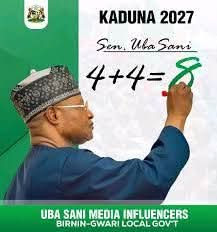
And as we look ahead, support for Uba Sani’s second term represents not just political continuity, but a collective commitment to a better future – one that leaves behind the shadows of our dark past and embraces the promise of progress.
~Edward John Auta is a historian, former member of the People’s Democratic Party, and Ambassador for Uba Sani’s Second Term.